 Napali Coast Boat Tours
Kauai Whale Watching: Season, Spots and Na Pali Boat Tours
Kauai whale watching is a winter activity. Humpbacks arrive from Alaska each winter and Kauai sees them from shore and from the water. This page covers the season dates with the conflicts between sources, the national marine sanctuary, the 100-yard rule, the shore spots and what winter Na Pali boat trips add. It links Napali Coast boat tours for the full comparison. No boat tour promises whales. Operators report sightings in season but never guarantee them.
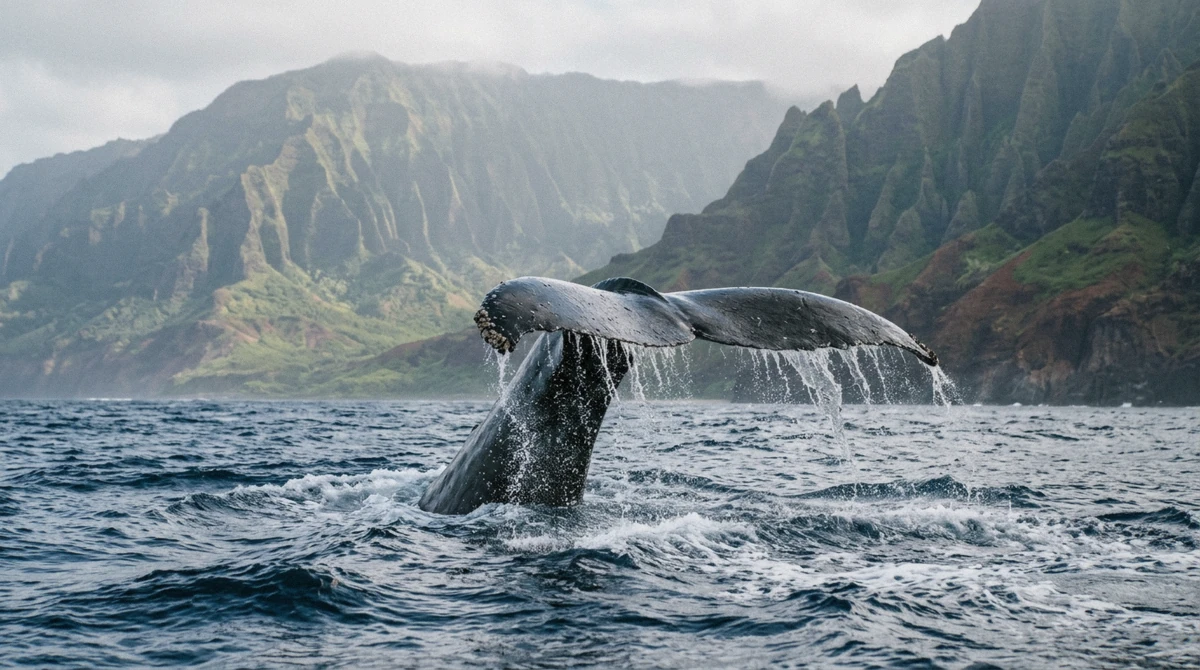
A humpback fluke off the Na Pali Coast in winter. Illustration.
Quick answer Kauai whale watching in brief
Kauai whale watching runs from about December to April, with the peak in January to March. More than half of North Pacific humpbacks winter in Hawaiian waters, per NOAA's sanctuary. You can watch from shore at Kilauea Point, Poipu and Hanalei Bay, or from a boat that also visits the Na Pali Coast. Federal law keeps boats 100 yards from a humpback, and no operator promises a sighting.
Key takeaways
- The winter tour table compares catamarans and rafts from $184.80 per person.
- The month-by-month season table shows where the sources agree and where they differ.
- Shore watching needs no boat ticket. See the best viewing spots from Kilauea Point to Hanalei Bay.
- Dolphins, turtles and the full wildlife rulebook live in the wildlife section of the Napali Coast boat tours comparison.
When the Humpbacks Are Here
The sources disagree on the exact edges of the season, so both sides are given. The peak is the part everyone agrees on.
The Season, With the Conflicts
NOAA's sanctuary site puts the migration at November through April and says more than half of the North Pacific's humpbacks use Hawaiian waters as their principal wintering ground. Holo Holo Charters says humpbacks are visible December through April. Captain J's runs its humpback watching from December 15 to March 31. Hawaii Magazine adds that mothers with calves leave in early May. The safe summary is roughly December to April, with January to March as the peak.
The same sources differ on whale numbers. Wikipedia counts about 21,000 humpbacks in the North Pacific. Hawaii Magazine puts Hawaii's winter population at as many as 10,000 per season, while Makana Charters says over 4,500 arrive in November. There is no official Hawaii count, so treat these as a range from different sources. The whales themselves are big enough not to miss: adults run 46 to 49 feet, and a blow plus a fluke at the surface is the usual tell. Hawaii Magazine notes adults exhale every 10 to 15 minutes, calves every 3 to 5 minutes.
| Month | Whales | Sea | Note |
|---|---|---|---|
| November | Early arrivals, sources differ on numbers | Rafts rougher in fall | NOAA starts the migration here |
| December | Present, per Holo Holo and Captain J's | Winter swell common | Captain J's whale watch starts December 15 |
| January | Peak | Winter swell common | Makana calls January to March peak |
| February | Peak | Winter swell common | Peak per Makana and Hawaii Magazine |
| March | Peak | Winter swell common | Captain J's whale watch ends March 31 |
| April | Tailing off | Swells common in winter and spring | Holo Holo ends its season note here |
| May | Mothers with calves leave in early May | Calming | Hawaii Magazine gives the early May exit |
| June to August | Outside the usual season | Calmer seas | Best for sea caves and snorkeling, not whales |
The Sanctuary and the Rules
The Hawaiian Islands Humpback Whale National Marine Sanctuary was established on November 4, 1992 and covers 1,400 square miles. Makana Charters says it covers depths within 600 feet and includes Hanalei Bay. Kauai Ocean Discovery in Lihue is the sanctuary's visitor center on the island, opened in 2020.
The key rule for any Kauai whale watching trip is distance. Federal rules bar approaching a humpback within 100 yards by any means, effective January 22, 2024. The rule covers waters within 200 nautical miles of Hawaii and limits aircraft to no lower than 1,000 feet. Makana states the same 100 yards for chartered boats. The sanctuary site keeps two hotlines: 888-256-9840 for entanglements and 800-853-1964 for violations. Its rescue network mounted 17 on-water entanglement responses in the 2024-2025 season. The community science arm is the Sanctuary Ocean Count, now 30 years old. The 2025 count put 1,353 volunteers at 44 sites over three days and tallied 4,782 whale sightings.
Sources: NOAA Hawaiian Islands Humpback Whale National Marine Sanctuary, Hawaii DLNR
Watching From Shore
You do not need a boat. Sea cliffs and south shore beaches are listed as viewing spots in season, though no sighting is promised.
Where to Stand
Makana Charters recommends Sealodge, Poipu, Kealia and Hanalei Bay beaches, plus Kilauea Lighthouse and the Kapaa Overlook. Its tips list adds Koloa Landing and the Kalalau Trail to the same set. Hawaii Magazine calls Kilauea Point National Wildlife Refuge the best Kauai whale spot, with sea cliffs hundreds of feet above the water. Hawaii Guide says the Kilauea lighthouse was built in 1913 and sits about 180 feet above the Pacific, roughly 23 miles north of Lihue. One caution: Hawaii Guide reports the refuge was closed for post-hurricane repairs with no reopening date when checked, so confirm the official status before you go.
Go Hawaii says Poipu Beach Park offers offshore humpback spotting from December to April. Makana says most sightings happen before 8am or after sunset, so an early start beats a midday stroll. Makana also lists the Kalalau Trail as a viewing spot, and the Kalalau Trail guide covers access rules. For the north shore generally, see Na Pali Coast and Haena State Park. Entry and parking rules differ by spot, and none promises a whale.
A Kauai Whale Watching Tour Review
A review of a Kauai whale watching tour. Third-party video by The Hawaii Vacation Guide. This site did not shoot it and has no relationship with the creator.
Whales From a Na Pali Boat
No tour on Kauai sells whales as its product. Holo Holo says it advertises no dedicated whale-watch tour, only Na Pali snorkel, Niihau and sunset trips. In season, captains report humpbacks along the coast anyway.
Winter Trips Compared
The table below pulls the card prices in US dollars from the booking platforms for catamaran and raft tours, and notes what each adds in whale season. Confirm each tour runs on your dates. Whale sightings are a bonus the operators report, never a promise.
| Tour | Boat | Price | Winter note |
|---|---|---|---|
| Na Pali Raft Snorkel | 14-seat rigid-hull raft, 5.5 hours | $184.80 per person | Lowest price here, small boat puts you near the water line |
| 'Imiloa Express Snorkel | 40-foot catamaran, 4.5 hours, up to 36 guests | $211.99 per person | Morning and afternoon departures from Port Allen |
| Lucky Lady Snorkel Cruise | 60-foot catamaran, 5.5 hours, up to 49 guests | $233.73 per person | Waterslide and open bar, lunch included |
| Amelia K Boat Tour | 47-foot powered catamaran, 5 hours, up to 32 guests | $227.13 per person | Sandwich lunch, age 4 and up |
| Zodiac Raft Sea Caves and Snorkel | 30-foot Zodiac raft, 3 to 4 hours | $225 per person | Kikiaola Harbor was closed by the state after Hurricane Lowell and is listed as closed until further notice, so confirm the departure point with the operator |
Catamaran or Raft, and the Winter Swell
Capt Andy's notes swells are more common in winter and spring while summer is calmer, which shapes the choice. A catamaran such as the Lady Kailani Luxury Snorkel at $260.91 gives you padded seating and shade on every deck, so a bumpier sea costs you less. A raft is wetter and rougher by design. Na Pali Riders describes its own ride as wild, sometimes fast and rough, and Hawaii Guide says rafts become significantly rougher in fall. Na Pali Riders excludes guests with back or neck problems, and both Na Pali Riders and Na Pali Experience bar pregnant passengers.
If whales are the whole point of your day, note that the super raft whale-watch trips from Port Allen head to Poipu waters, not the Na Pali Coast. Captain J's runs those on 37-foot Super Rafts carrying up to 28 passengers with a minimum age of 4, from December 15 to March 31. For the coast itself, morning departures win in winter: Na Pali Riders says mornings have better conditions and afternoons grow bumpier as the wind picks up. Holo Holo asks guests to check in early for the same reason. For the full harbor picture, see Port Allen and Kikiaola Harbor, and the harbors section of the homepage.
Sources: Holo Holo Charters, Capt Andy's
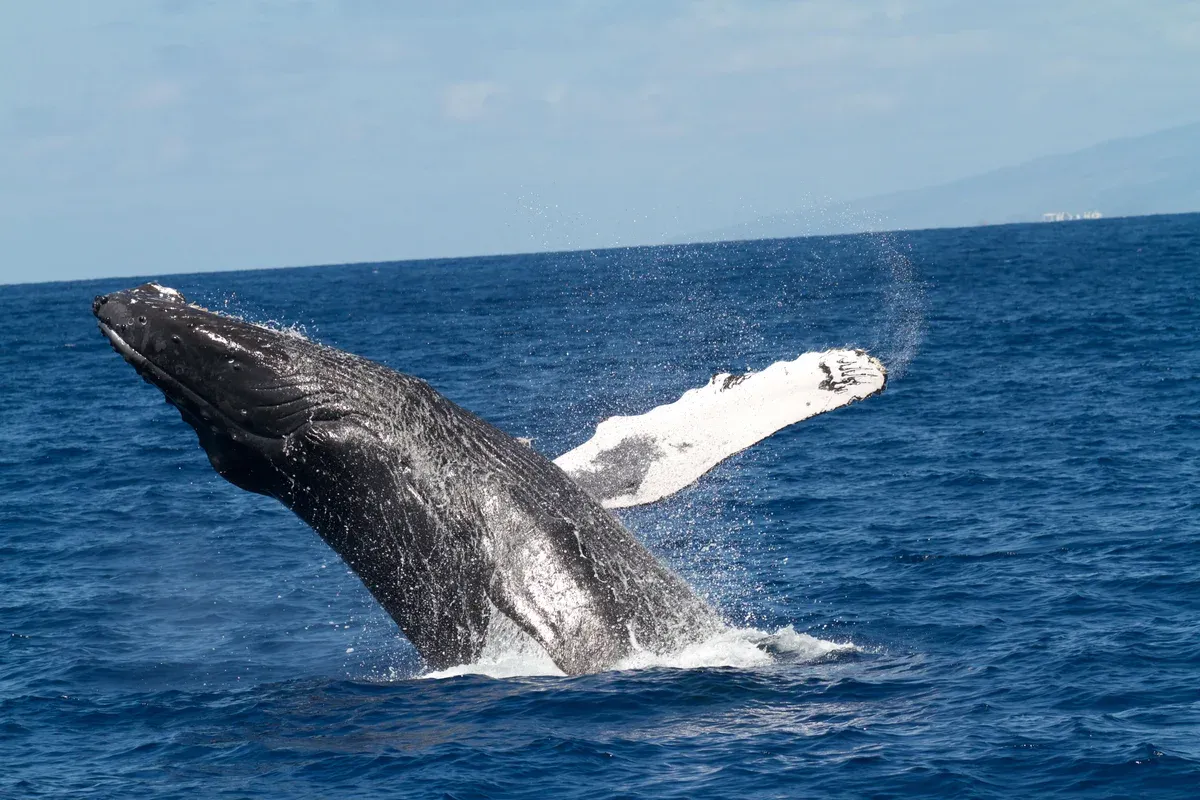
A humpback whale shows its long white flipper as it breaches in Hawaii. Photo: National Marine Sanctuaries, Public domain, via Wikimedia Commons
Whale Season Tips
Do
- Do go in January through March, because Makana and Hawaii Magazine both put the peak in that window.
- Do watch from shore before 8am or after sunset, because Makana Charters says most sightings fall in those hours.
- Do choose a morning boat departure in winter, because Na Pali Riders says mornings have better conditions before the wind picks up.
- Do keep 100 yards from any humpback by any means, because the federal rule effective January 22, 2024 applies to swimmers, boats and drones alike.
- Do take seasickness medication before boarding and skip alcohol, because Holo Holo gives that advice for seasickness.
Don't
- Don't book a Na Pali tour expecting whales as part of the price, because no operator promises a sighting.
- Don't fly a drone low over the water, because aircraft must stay at least 1,000 feet above humpbacks under the federal rule.
- Don't assume Kilauea Point is open, because Hawaii Guide reports it was closed for post-hurricane repairs with no reopening date when checked.
- Don't assume every harbor is running, because Kikiaola is listed as closed until further notice after Hurricane Lowell, so confirm the departure point with the operator.
Humpback Behavior and What You Might See
Winter in Hawaii is about breeding and calves, per Hawaii Magazine.
Why the Whales Are Here and What They do
Humpbacks travel roughly 3,000 miles from southeast Alaska to breed in Hawaii, per Hawaii Magazine, and Wikipedia records individuals covering up to 8,000 km one way. Females calve every two years after an 11.5-month gestation. Adults reach 14-15 m (46-49 ft) and calves are born about 4.3 m (14 ft) long and 680 kg. Adults exhale every 10-15 minutes and calves every 3-5 minutes, per Hawaii Magazine, so calves surface more often.
How many whales come is disputed, because no official Hawaii count exists. Hawaii Magazine puts the state total at as many as 10,000 per season. Makana Charters says over 4,500 humpbacks arrive in November. Wikipedia counts about 21,000 humpbacks in the whole North Pacific and NOAA's sanctuary site says more than half of those use Hawaiian waters as their principal wintering ground. Treat the honest answer as a range in the thousands, not one number. Most sightings from shore happen before 8am or after sunset, per Makana.
- Breaching, when a whale throws itself clear of the water
- Tail slaps and pectoral fin slaps on the surface
- Mothers with calves, which leave in early May per Hawaii Magazine
The Sanctuary Ocean Count
The Hawaiian Islands Humpback Whale National Marine Sanctuary was established November 4, 1992 and covers 1,400 square miles, including Hanalei Bay and waters within 600 feet of depth, per Makana Charters. Kauai Ocean Discovery in Lihue is its visitor center on the island, opened in 2020. The count itself is a community science project about 30 years old run by NOAA. Volunteers sit at shoreline sites on three count days and log every humpback they see.
The 2025 count drew 1,353 volunteers at 44 sites and recorded 4,782 whale sightings over the three days, per NOAA. The count is one structured way to watch whales and it feeds community research. The sanctuary also runs the rescue side: NOAA mounted 17 on-water entanglement responses in the 2024-2025 season and lists 888-256-9840 for entanglements and 800-853-1964 for violations. The broader comparison of Napali Coast boat tours on the homepage covers which winter departures put you on the water, while the count covers the view from land.
How Close a Boat May Legally Get
Federal and NOAA rules set hard distances for every animal you might meet on a winter Kauai whale watching tour. The humpback rule took effect January 22, 2024 and covers waters within 200 nautical miles of Hawaii. Charter boats may not come within 100 yards of a whale, and Makana states the same limit for its own charters.
The table below gathers the federal humpback rule and the NOAA viewing distances so you know what a legal encounter looks like from the deck.
| Rule | Distance | Applies to |
|---|---|---|
| Federal humpback rule, in force since January 22, 2024 | No approach within 100 yards, by any means | Humpback whales, waters within 200 nautical miles of Hawaii |
| Federal humpback rule, aircraft limit | No lower than 1,000 feet | Aircraft over humpback waters |
| NOAA viewing guideline | Stay at least 50 yards | Dolphins and small whales |
| NOAA spinner dolphin rule, in force since October 28, 2021 | No approach or swim within 50 yards, no interception, within 2 nautical miles of the main islands | Spinner dolphins |
| NOAA viewing guideline | Stay at least 50 feet, and 150 feet from a mother with pup | Hawaiian monk seals |
| NOAA viewing guideline | Stay at least 10 feet | Sea turtles |
Report, do Not Chase
If spinner dolphins approach your boat, the vessel underway may continue normal navigation but the crew may not pursue them. For whales, stay 100 yards away. If you see an entangled or injured whale from shore or from a boat, call the NOAA entanglement hotline at 888-256-9840 rather than going closer.
Do not swim toward whales from a tour stop. The rules exist to protect the animals.
Planning a Winter Boat Day
Winter changes the water on the north shore of Kauai. Here is what that means for the boats, your stomach and your chances of seeing a whale.
Winter Seas, Reroutes and Mornings
Swells are more common in winter and spring, per Capt Andy's, and Hawaii Guide says rafts become significantly rougher in fall before the big winter swell even arrives. Hawaii Guide says catamarans run year-round while some raft products do not: Na Pali Riders runs its sea-cave-only raft expedition May 17 to September 20 and keeps only its snorkel plus caves tour going year-round. Blue Dolphin notes its seasonal whale watching runs from the South Shore, and Kauai.com lists an afternoon catamaran with no snorkel for November to April.
Morning is the better time to go. Na Pali Riders says morning tours have better conditions and afternoons are bumpier as the wind picks up. Holo Holo asks guests to check in early to catch typically calmer morning conditions, and Makana says most whale sightings happen before 8am or after sunset. Kikiaola Small Boat Harbor was closed by the state after Hurricane Lowell and is listed as closed until further notice, so confirm the departure point with the operator before you travel. For seasickness, Holo Holo advises taking medication beforehand, avoiding alcohol and acidic drinks and resting well. Na Pali Experience says much the same: sleep well, eat bland foods, take Bonine if you are prone.
- Pick the earliest departure offered, not the sunset slot, if whales are the goal
- Catamarans handle winter swell better than small rafts
- Weather cancellation by the operator brings a full refund, per Holo Holo
Catamaran or Raft, and Which Tours Mention Whales
For Kauai whale watching in winter, a catamaran is the steadier platform and the more realistic choice. Holo Holo says humpbacks are visible December through April, though it advertises no dedicated whale-watch tour, only Napali snorkel, Niihau and sunset trips. Whales are never promised on any of these boats, so treat a sighting as a bonus on a trip you would book anyway for the cliffs. Hawaii Guide says catamarans run year-round, so these are winter options, with sailings decided by the sea on the day: the Holo Holo Sail and Snorkel at $274 per person, the Lucky Lady Snorkel Cruise at $233.73, the Amelia K Boat Tour at $227.13 and the Niihau and Na Pali Full Day at $339.
Rafts are the rougher ride in winter. The 30-foot Zodiacs of Na Pali Riders and the 24-foot rafts of Kauai Sea Tours take the swell hard, and Hawaii Guide describes the fall ride as significantly rougher. One raft exception does target whales: Captain J's runs dedicated whale-watching on its two 37-foot Super Rafts, which carry up to 28 passengers with a restroom, shade and a swim ladder, and its whale-watch minimum age is 4. Note those super raft trips leave Port Allen for Poipu waters, not the Na Pali Coast, and Captain J's runs humpback watching December 15 to March 31. Dolphins and turtles are covered in depth in the wildlife section of the Napali Coast boat tours homepage.
Kauai Whale Watching FAQ
What is the best month to see whales in Kauai?
Any month from January to March, which Makana Charters and Hawaii Magazine both call the peak. The wider season runs roughly December to April. Pick a winter catamaran tour for the coast, or read the month-by-month table for the edges of the season.
Can you see whales in Kauai from shore?
Yes. Makana Charters lists Kilauea Lighthouse, Kapaa Overlook, Sealodge, Poipu, Kealia, Koloa Landing and Hanalei Bay as viewing spots, and Go Hawaii confirms offshore spotting at Poipu Beach Park from December to April. Most sightings happen before 8am or after sunset, per Makana. The shore spots section has the details.
Do I need a boat tour to see humpbacks in Kauai?
No. Shore watching at the best viewing spots needs no boat ticket, though some spots charge entry or parking, and Hawaii Magazine calls Kilauea Point the island's best whale spot. A boat adds the Na Pali cliffs and a closer vantage, but captains must stay 100 yards away, the same distance the federal rule sets for everyone.
How close can a boat get to a humpback whale in Hawaii?
100 yards is the limit. Federal rules bar approaching a humpback within 100 yards by any means, effective January 22, 2024, and the rule covers waters within 200 nautical miles of Hawaii. Makana Charters repeats the same 100 yards for its chartered boats. The sanctuary and rules section lists the NOAA hotlines for reporting violations.
Are there dedicated whale watching tours on Kauai?
Yes, but they do not run the Na Pali Coast. Captain J's runs humpback watching December 15 to March 31 on Super Rafts from Port Allen, and Hawaii Guide-based reporting says those whale-watch trips head to Poipu waters instead of the coast. Holo Holo says it advertises no dedicated whale-watch tour. For the coast itself, see the winter tour comparison.
How many humpback whales come to Hawaii each winter?
The sources give a range with no official count. Wikipedia counts about 21,000 humpbacks in the North Pacific, NOAA's sanctuary says more than half of them winter in Hawaiian waters, Hawaii Magazine puts the state total at as many as 10,000 per season and Makana says over 4,500 arrive in November. Read the season section for how the numbers fit together.